
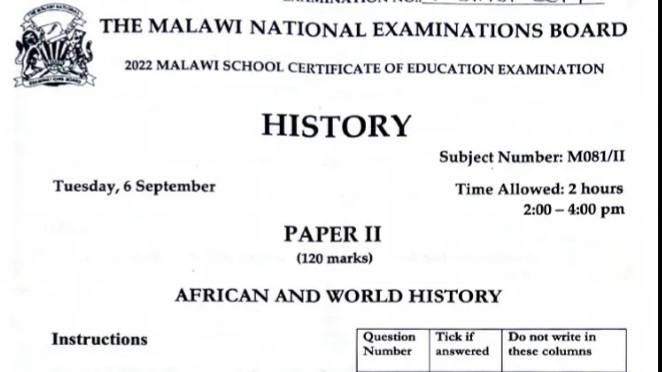
Essay questions are a real challenge for many MSCE students, especially when you aren’tlly prepared. But today, I’m sharing the exact strategy that helped me become the best History student at Zomba Catholic Secondary School in 2019.
And no, I’m not exaggerating. On many of my history answer sheets, I used to score 25 out of 20 or even 28 out of 20. Sounds crazy? It’s true — and the secret was in how I structured my essays.
So let’s get straight to the point. I want to show you exactly how you can write an MSCE History essay that not only gets full marks… but goes beyond.
✍️ Step 1: Master the Format
Every essay must follow this structure:
💧A heading
💧A brief introduction summarizing what your essay will cover
💧A body with well-developed paragraphs
💧A conclusion that wraps everything up clearly
Simple, right? But here’s the trick most students miss…
🎯 Step 2: Understand the Open-Ended Structure of MSCE History Essays
Most History essay questions in MSCE are not limited to “three points only” or “four reasons.” They are open-ended. That means you’re free to include as many valid points as you can.
This is exactly what I did: for each essay, I wrote at least 7 to 10 clear, factual points.
And this is how it paid off…
Each paragraph can earn you up to three marks:
💧One for stating the point,
💧One for explaining it,
💧One for giving a solid historical example.
So, if you write 7 paragraphs and each one is worth up to 3 marks, you can easily go beyond the standard 20 marks. That’s how I ended up with scores like 25 or even 28 out of 20.
Let’s apply this strategy to a common World History question.
❓ Question: Discuss the causes for the partition of Africa by European powers in the 19th century.
Introduction:
The partition of Africa, also known as the Scramble for Africa, was a period in the late 19th century when European powers rapidly divided the African continent among themselves. Several political, economic, and strategic factors pushed European countries to compete for African territory. This essay outlines the major causes that led to this scramble.
1. Search for Raw Materials
European countries needed raw materials such as cotton, rubber, palm oil, and minerals to fuel their growing industries. Africa was seen as a continent rich in untapped resources. This need pushed countries like Britain and France to claim African territories for economic gain.
2. Industrial Revolution in Europe
The industrial revolution created a demand for new markets where European goods could be sold. African territories provided a perfect market for manufactured goods and a source of cheap labor. This drove European nations to colonize new regions.
3. Strategic and Military Interests
European powers wanted control of important routes and naval bases. For example, Britain’s control of Egypt and the Suez Canal was strategic for its route to India. Military advantage and global influence became reasons to claim key African regions.
4. Competition Among European Powers
There was intense rivalry among European countries such as Britain, France, Germany, and Portugal. Each nation wanted to prove its strength by acquiring more colonies. The Berlin Conference of 1884–85 formalized this competition and led to the division of Africa.
5. Spread of Christianity and Western Civilization
Missionaries played a role in promoting colonization. They believed that Africans needed to be “civilized” through religion, education, and European culture. Colonization was presented as a way to uplift African societies spiritually and morally.
6. National Prestige and Imperial Glory
Colonial expansion was tied to national pride. Countries believed that having many colonies showed power and global dominance. Colonies were seen as trophies — a symbol of greatness on the international stage.
7. Technological Superiority
European countries had advanced weapons, steamships, and better communication tools like the telegraph. This gave them confidence to invade and conquer African territories with little resistance. Technology made the partition easier and faster.
8. Adventure and Exploration
Explorers such as David Livingstone and Henry Morton Stanley mapped unknown parts of Africa. Their reports attracted interest back home and encouraged governments and businesses to claim these new lands before others could.
Conclusion:
The partition of Africa was not caused by one factor but by a combination of political, economic, religious, and technological forces. European powers were driven by the desire for wealth, control, and prestige. The result was the rapid colonization of nearly the entire continent by the end of the 19th century.
🧠 Final Word from Skillfex
So if you want to pass your MSCE History exam with flying colors:
- Don’t limit yourself to 3 or 4 points — go for 7 or more.
- Include examples for every point.
- Stick to the format.
- Practice regularly with past papers.
Need help mastering this style?
📚 Join Skillfex Academy and let us help you crush essay questions in History and other MSCE subjects.
